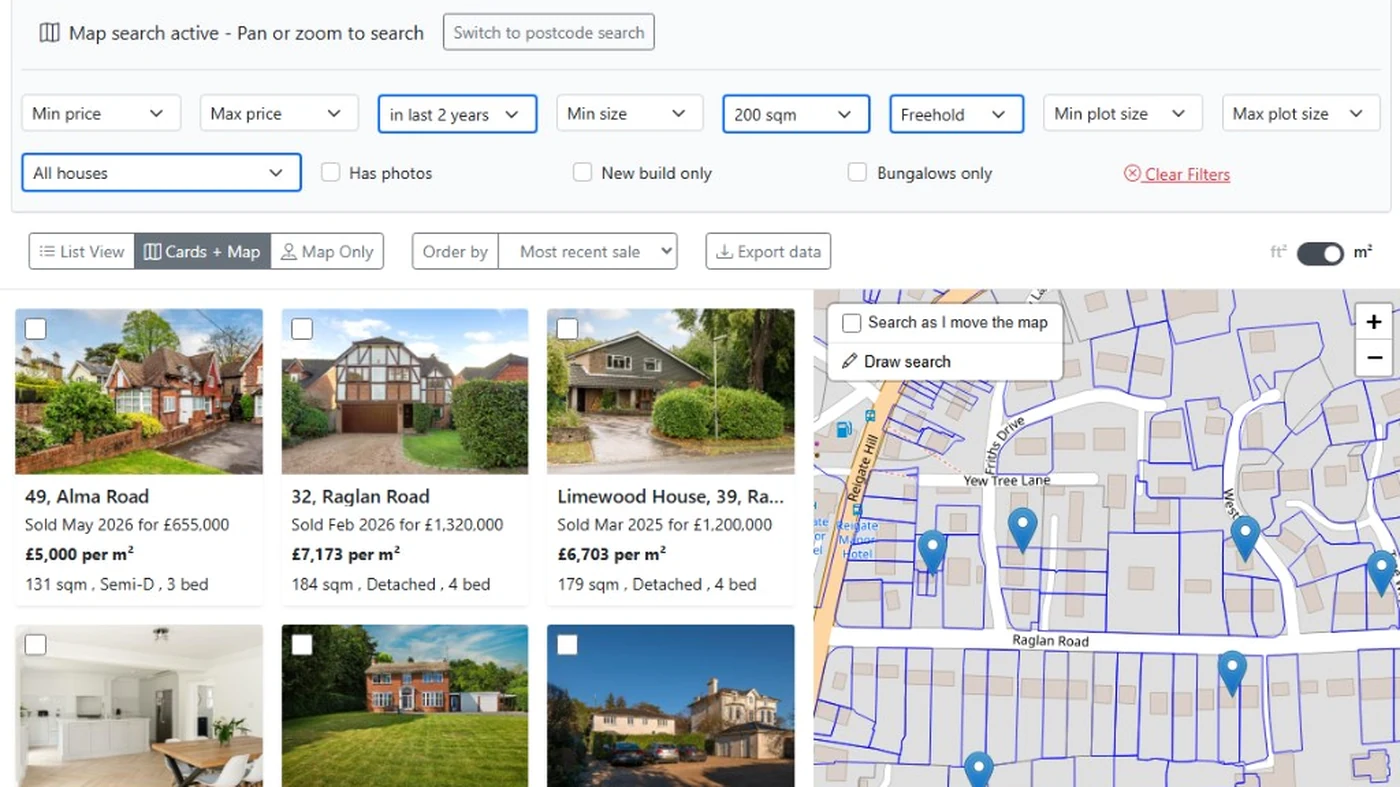
A comparable is a property sale that helps you judge what another property might be worth. The best comparable is not simply the nearest sale or the latest sale. It should be similar in the ways buyers value and recent enough to reflect the same local market.
You rarely find one perfect match. A better approach is to build a small group of useful sales, understand the differences, and explain why each one belongs in the comparison.
Advanced Search, shortlists and the comparable evidence report are part of a premium subscription. Open them from Search, or go straight to Advanced Search.
Start with the property you are assessing
Write down the important facts about the subject property before searching:
- address and postcode;
- house or flat;
- detached, semi-detached or terraced;
- freehold or leasehold;
- approximate internal floor area;
- plot size, parking and outside space;
- aspect, e.g. south facing; and
- condition, extensions and significant improvements.
More subjective facts such as "Recently modernised" and "better position" need evidence from photographs or mapping.
If the subject property has a HouseMetric page, use it to check its sale history, EPC floor area and other available records before opening Advanced Search.
Search nearby first
Begin with the full postcode and a modest radius. Location is usually the strongest starting point because values can change between neighbouring streets, school catchments, estates or opposite sides of a main road.
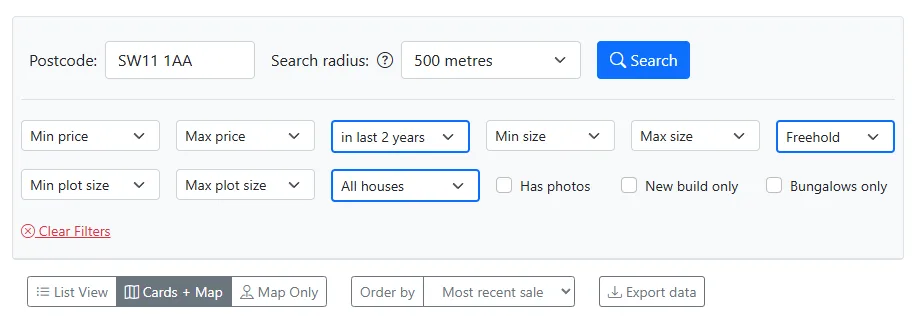
If too few suitable sales appear, widen the radius gradually. Do not jump immediately to a large area simply to create a longer list. A nearby property of a slightly different size may be more informative than an apparently identical property in a different market.
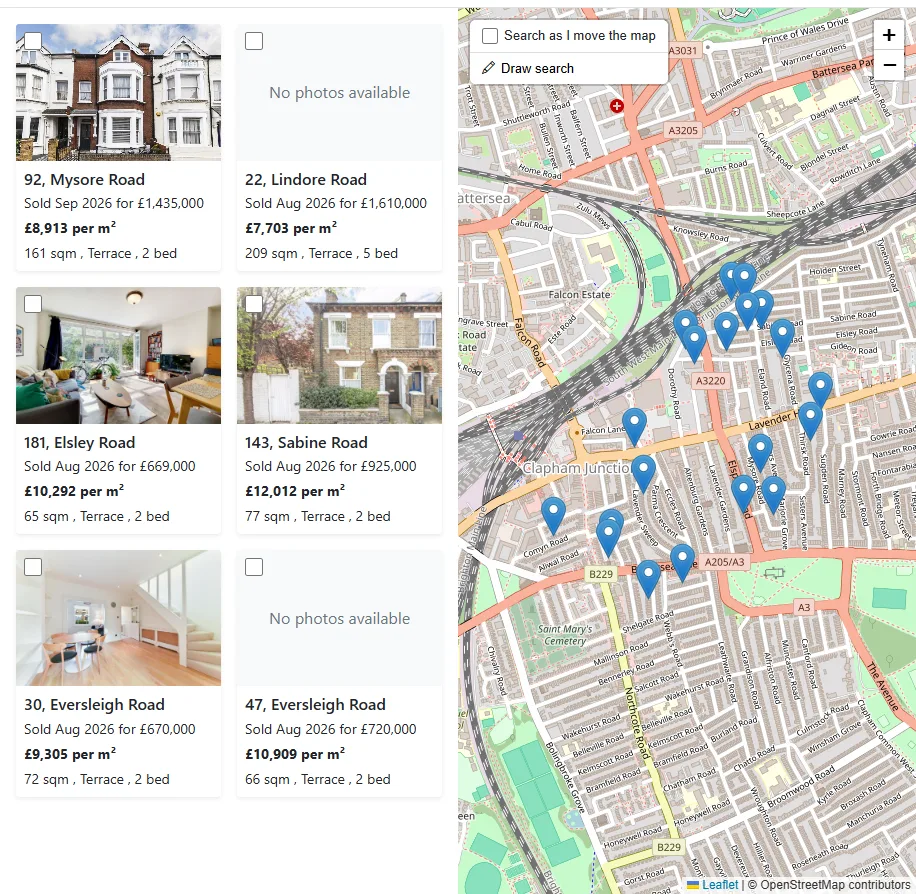
The map view helps reveal barriers and changes in setting that a distance alone can miss. Look for railway lines, busy roads, parks, waterfronts, estate boundaries and differences in the surrounding housing.
The cards and map below are that same search, as at publication. Run it again for the current list.
Match the characteristics that matter
Property type
Compare like with like where possible. A flat should normally be compared with flats, a terrace with terraces and a detached house with detached houses.
Be cautious with broad labels. Two detached houses can have very different floor areas, plots, ages and conditions. A bungalow can attract a different group of buyers from a two-storey house, even when their floor areas are similar.
Tenure
Keep freehold and leasehold properties separate unless you have a clear reason not to. For flats, the remaining lease, service charge, ground rent, building condition and share-of-freehold arrangements can materially affect the price, but these details are not all contained in Price Paid Data.
Floor area
Internal floor area is often more useful than bedroom count. Bedrooms can be divided, combined or described differently, while floor area gives a common measure of the accommodation.
Use the minimum and maximum size filters to find properties in a sensible band around the subject. Then inspect the individual floor areas rather than treating everything inside the band as identical.
HouseMetric generally takes floor area from Energy Performance Certificates. EPC measurements can differ between inspections and may not include a recent extension, so check the certificate date and any later property records.
Plot and outside space
Plot size matters most for houses where gardens, parking and development potential influence demand. It is less useful on its own for flats or developments with shared land.
A large plot does not automatically add value in proportion to its area. Shape, access, slope, planning constraints and how much of it is usable all matter.
Condition
Condition cannot be reduced to a reliable database filter. Use archived listing photographs where available and add a note to each shortlisted comparable. A renovated home and a property needing major work should not be treated as equal merely because their recorded facts match.
Keep the sale dates relevant
Recent sales usually describe the current market better, but older sales can still be useful when there are few genuinely similar properties.
Start with a recent period. Expand it only when the initial search does not provide enough evidence. When you include an older sale, acknowledge that the market may have moved since it completed.
HouseMetric's "today's value" can put an older price into current market context, but it is an indexed version of that historic price, not a fresh valuation of the property. It cannot account for work carried out since the sale or whether the original transaction was unusually high or low.
Very recent months are also incomplete because Land Registry sales arrive gradually. A missing recent comparable may appear in a later data update.
Compare total price and price per square metre
Total sale price answers what the buyer paid for the whole property. Price per square metre helps separate size from price.
Use both:
- If two homes sold for similar totals but one is much larger, they are not equivalent evidence.
- If two homes have similar price per square metre but very different plots or condition, the similarity may be misleading.
- Small properties can have a higher price per square metre because kitchens, bathrooms and the value of the site are spread across fewer square metres.
Price per square metre is a comparison tool, not a valuation formula. Multiplying one local rate by the subject's floor area ignores condition, plot, layout, tenure and other qualitative differences.
Investigate unusual sales before excluding them
An unusually high or low result may be useful evidence, an error or a transaction with circumstances that are not obvious from the basic record.
Open the property page and consider:
- whether the floor area & photos belong to the property sold (address matching errors);
- whether it was a new build;
- whether the property type or tenure differs;
- whether more than one property may have been involved;
- whether an extension or redevelopment changed the property;
- whether the sale is marked as additional Price Paid Data.
Do not remove an awkward result merely because it disagrees with the answer you expected. Record why it is less comparable.
Build a shortlist
In Advanced Search, select the useful results and add them to a shortlist. A practical shortlist should contain the strongest evidence, not every sale returned by the search.
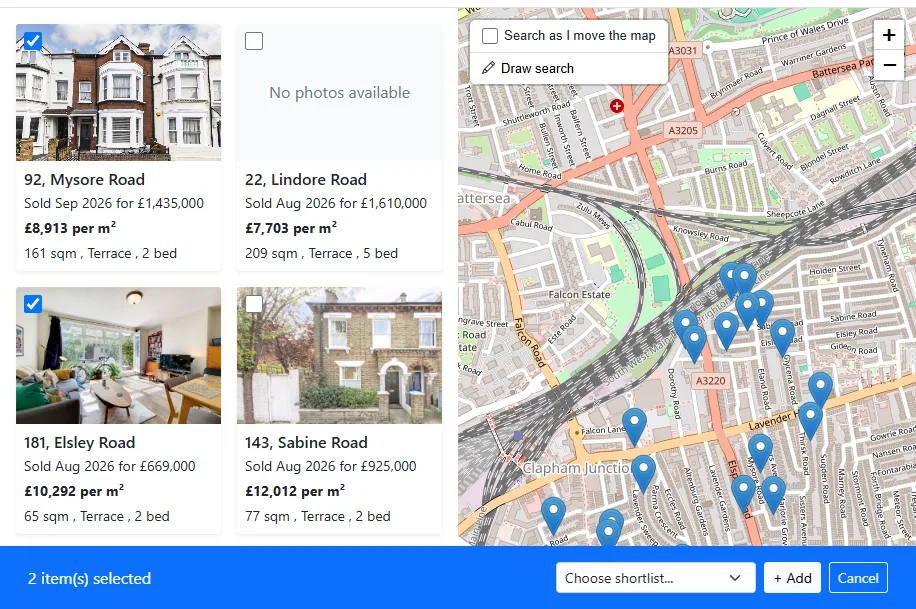
For each property, add a short note such as:
- similar terrace and floor area;
- same estate but inferior position;
- larger plot;
- leasehold flat with unknown lease length;
- newly refurbished; or
- older sale included because there are few recent matches.
The shortlist summary shows the selected properties' average sale price, price range, average floor area and average price per square metre. Those figures describe only the properties you selected. They become misleading if the shortlist mixes unrelated property types or if weak comparables outnumber strong ones.
Produce a comparable evidence report
Open the shortlist and set the subject property. If it is not listed, you can enter its address manually.
The comparable evidence PDF can include:
- a cover page with the subject property;
- its available property profile and records;
- a summary of the selected comparables; and
- a property-by-property comparables table.
You can also export the shortlist as a table PDF or CSV. Review the selection and notes before exporting: a polished report cannot correct poor comparable choices.
A useful final check
Before relying on the result, ask:
- Are the comparables genuinely from the same local market?
- Have I kept property type and tenure consistent?
- Are their floor areas reasonably similar?
- Have I considered condition, plot and setting?
- Are the sales recent enough, or have I explained the older ones?
- Can I explain why every property is included?
- Would removing one unusual sale materially change the conclusion?
Comparable evidence supports judgement; it does not replace it. HouseMetric can organise the public records and make differences easier to see, but it cannot inspect condition or know every term of a transaction. For a formal valuation, instruct an appropriately qualified professional.