House prices in 'CM16 4', Epping
Price per square foot data and charts revealed. Latest statistics for the housing market in 'CM16 4' (Epping) - calculated on 11 April 2026.
Defining 'CM16 4'
This analysis is limited to properties whose postcode starts with "CM16 4", this is also called the postcode sector. There are no official postcode sector names so I've just labelled it CM16 4, Epping. It is shown in red on the map below.
Want to change geography?
You can click on the map above to change to a neighbouring sector, or you can use the search form below.
Price per square foot
Knowing the average house price in CM16 4 is not much use. However, knowing average price per square foot can be quite useful. Price per sqft allows some comparison between properties of different size. We define price per square foot as the sold price divided by the internal area of a property:
£ per sqft = price ÷ internal area
For example in February 2026, 149, Theydon Grove, Epping, CM16 4QB sold for £820,000. Given the internal area of 1,474 square feet recorded on the EPC, the price per sqft is £820,000 ÷ 1,474 sqft = £556.
England & Wales have been officially metric since 1965. However house price per square foot is prefered by some estate agents and those of sufficiently advanced age ;-). You can change your prefered units from square meters to square feet for all the graphs and charts on CM16 4 and elsewhere. Just visit the My Account page and look for the m2 to ft2 toggle switch. Alternatively just multiply everything by 10, move a decimal place to go from sqm to sqft and you'll be close enough as 1 sqm = 10.76391 sqft.
Distribution of £ per sqft for 'CM16 4' vs 'CM16'
The chart above is called a histogram, it helps you see the distribution of house price per sqft in CM16 4 To make this chart we put all the sales data into a series of £ per sqft 'buckets' (e.g. £582 to £600, £600 to £618, £618 to £636 etc...) we then count the number of sales with within in each bucket and plot the results. The histogram is based on 138 sales that took place in CM16 4, Epping in the last 24 months.
Generate a custom histogram like the one above but based on your own criteria.
You can see the spread of prices above. This is because although internal area is a key factor in determining valuation, it is not the only factor. Many factors other than size affect desirability; these factors could be condition, aspect, garden size, negotiating power of the vendor etc.
The spread of prices will give you a feel of the typical range to expect in CM16 4, Epping. Notably, only 25% of properties that sold recently were valued at more than £611 sqft. For anything to be valued more than this means it has to be more desireable than the clear majority of CM16 4 homes.
Box plot of £ per sqft for CM16 4
Tip: click on the chart to see the values.
The chart above is called a boxplot (or a box-and-whisker plot). Box plots, like histograms, are used to graphically represent the distribution of data, showing the central tendency, spread of the distribution. In the context of £ per square foot property price distributions, box plots represent the variation in property prices within a geographic area e.g. Epping. The chart above shows a boxplot for 'CM16 4' as well as the 'CM16' postcode district.
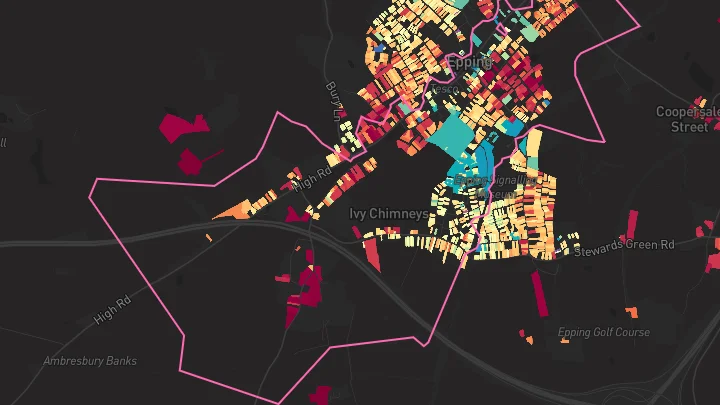
Property price map for Epping
Have a look at the interactive price map I created for myself. Use it to explore house prices in 'Epping' all the way down to individual property plots.
Epping house price forecasting
House prices in CM16 4 grew 17.2% in the last year, 13.5% after inflation. Whether or not this trend will continue depends on many factors, such as wage growth, net migration, interest rates and the level of house building. No one can predict these things with certainty however we can plot the historic trends in house prices in CM16 4 (Epping) compared with the wider postcode district of CM16.
House price index for CM16 4
Tip: click on the legend items to show/hide different lines
Download house price index as CSV (premium users only).
The chart above shows changes in 'CM16 4' property prices over the last 20 years. The index is calculated from the average price paid per sqft for property in CM16 4 and is set to 100 in 2004. I'm comparing the trends for CM16 4,Epping with the wider postcode district of CM16 What is more interesting is to look at the difference between flats and houses, even those in the same area follow a very different trend, to get a robust enough sample size to see this we need to zoom out and look at house price trends for the entire Epping Forest local authority.
The dashed lines show nominal house price changes, the solid lines show the same data adjusted for inflation. Economists call this the 'real' price change. You have to take inflation into account when comparing prices over time. It's calculated using the formula:
Real Rate of Return = (1 + Nominal Rate) ÷ (1 + Inflation Rate) – 1In this formula, the nominal rate is the rate of change before any adjustments, and the inflation rate is taken from the Consumer Price Index. The real rate of return is a more accurate measure of change in value, because £1 today does not have the same buying power as £1 in the past. For example, if a savings account pays an interest rate of 3% per year and the inflation rate is 5% per year, the real rate of return is -2%. This means that the investment's value is shrinking by 2% each year.
Historic returns for CM16 4
| CM16 4 sector | CM16 district | |||
|---|---|---|---|---|
| Nominal | Real | Nominal | Real | |
| 20 yr per annum | 3.7% | 0.8% | 3.4% | 0.6% |
| 20 yr total | 106.1% | 18.3% | 95.4% | 12.1% |
| 10 yr per annum | 2.5% | -0.8% | 1.4% | -1.9% |
| 10 yr total | 28.6% | -7.8% | 15.1% | -17.5% |
| 5 yr per annum | 3.5% | -1.4% | 1.1% | -3.7% |
| 5 yr total | 18.7% | -6.9% | 5.7% | -17.1% |
| 1 yr per annum | 17.2% | 13.5% | -0.8% | -3.9% |
| 1 yr total | 17.2% | 13.5% | -0.8% | -3.9% |
This table complements the house price index chart above, presenting the data in a more detailed format. It breaks down the information into 20-year, 10-year, 5-year, and 1-year periods, further categorized by property type. For each period, we display both a per annum rate of change and a total rate of change.
The total rate of change represents the overall change over the entire period. The formula for total return is:
Total return = (Index at end of period ÷ Index at start of period) - 1
The per annum rate of change is the annualized rate of change over the period. This is equivalent to the annual bank savings rate you would need to achieve the same total return over the given period. This annualized return is also known as the Compound Annual Growth Rate (CAGR). The formula for CAGR is:
CAGR = (1 + Total return) ^ (1 ÷ Number of years) - 1
Some specific examples:
- Over the past 20 years, CM16 district have seen a 0.6% annual change when adjusted for inflation. This translates to a total change of 12.1% in real terms.
- Over the past 5 years, CM16 district have seen a -3.7% annual change when adjusted for inflation. This translates to a total change of -17.1% in real terms.
Most recent CM16 4 sales
For the most recent sales activity, rather than a summarized average, it is better to see the underlying data. This is shown in the chart below, where blue dots represent individual sales, click on them to see details. If there is an obvious trend you should be able to spot it here amid the noise from outliers.
Tip: hover over dots to see details
Street level data
| Street | Avg size | Avg £sqft | Recent sales |
|---|---|---|---|
| Hemnall Street, Epping, CM16 4L | 882 sqft | £588 | 29 |
| Woodland Grove, Epping, CM16 4N | 505 sqft | £583 | 20 |
| Hartland Road, Epping, CM16 4P | 1,108 sqft | £501 | 13 |
| Station Road, Epping, CM16 4H | 1,076 sqft | £677 | 12 |
| Theydon Grove, Epping, CM16 4P | 1,614 sqft | £528 | 12 |
| Cedar Court, Epping, CM16 4H | 559 sqft | £488 | 10 |
| High Street, Epping, CM16 4F | 602 sqft | £635 | 8 |
| Centre Drive, Epping, CM16 4J | 990 sqft | £586 | 8 |
Search for your street here.
Nearby geographies
The table below shows how 'CM16 4' compares to the other postcode sectors in CM16.
| Sector | Lower quartile | Median | Upper quartile | Sales in last 2yr |
|---|---|---|---|---|
| CM16 7 Theydon Bois | £518 sqft | £582 sqft | £667 sqft | 198 |
| CM16 6 North Weald | £430 sqft | £495 sqft | £572 sqft | 210 |
| CM16 5 Epping | £524 sqft | £569 sqft | £642 sqft | 108 |
| CM16 4 Epping | £491 sqft | £541 sqft | £611 sqft | 138 |
Raw data
Our analysis of CM16 4 is derived from what is essentially a big table of sold prices from Land Registry with added property size information. Below are three rows from this table to give you an idea.
| Address | Paid | sqft | £/sqft |
|---|---|---|---|
| 149, Theydon Grove, Epping | £820,000
Feb-2026
|
1,474 | 556 |
| 73, Centre Drive, Epping | £572,000
Feb-2026
|
850 | 672 |
| Flat 8 Tennyson House, Addison Court, Epping | £346,000
Feb-2026
|
538 | 642 |
About
I created HouseMetric because I wanted to see this data and analysis myself, I also wanted to teach myself to build a website. Please give me feedback or spread the word about it. I'm constantly tinkering and adding more stuff to it.