House prices in E (East London)
Price per square metre data and charts to help you understand the housing market in E - stats were last calculated on 08 October 2026.
Defining postcode area 'E'
This analysis is limited to properties whose postcode starts with "E", this is also called the postcode area. There are no official postcode area names so I've just labelled it E, East London. It is shown in red on the map below.
Want to change geography?
You can click on the map above to change to a neighbouring area, or you can use the search form below.
Price per square metre
Knowing the average house price in E is not much use. However, knowing average price per square metre can be quite useful. Price per sqm allows some comparison between properties of different size. We define price per square metre as the sold price divided by the internal area of a property:
£ per sqm = price ÷ internal area
For example in August 2026, Flat 11 87 - 91, Hackney Road, East London, E2 8FE sold for £525,000. Given the internal area of 86 square metres recorded on the EPC, the price per sqm is £525,000 ÷ 86 sqm = £6,104.
England & Wales have been officially metric since 1965. However house price per square foot is prefered by some estate agents and those of sufficiently advanced age ;-). You can change your prefered units from square meters to square feet for all the graphs and charts on E and elsewhere. Just visit the My Account page and look for the m2 to ft2 toggle switch. Alternatively just multiply everything by 10, move a decimal place to go from sqm to sqft and you'll be close enough as 1 sqm = 10.76391 sqft.
Distribution of £ per sqm for houses vs flats in E
Tip: click on the legend labels to show/hide different property types.
The chart above is called a histogram, it helps you see the distribution of house price per sqm in E To make this chart we put all the sales data into a series of £ per sqm 'buckets' (e.g. £6,693 to £7,084, £7,084 to £7,476, £7,476 to £7,867 etc...) we then count the number of sales with within in each bucket and plot the results. The histogram is based on 6,607 sales that took place in E in the last 12 months.
Generate a custom histogram like the one above but based on your own criteria.
You can see the spread of prices above. This is because although internal area is a key factor in determining valuation, it is not the only factor. Many factors other than size affect desirability; these factors could be condition, aspect, garden size, negotiating power of the vendor etc.
The spread of prices will give you a feel of the typical range to expect in E, East London. Notably, only 25% of properties that sold recently were valued at more than £7,950 sqm. For anything to be valued more than this means it has to be more desireable than the clear majority of E homes.
Box plot of £ per sqm for E
Tip: click on the chart to see the values.
The chart above is called a boxplot (or a box-and-whisker plot). Box plots, like histograms, are used to graphically represent the distribution of data, showing the central tendency, spread of the distribution. In the context of £ per square metre property price distributions, box plots represent the variation in property prices within a geographic area e.g. E. The chart above shows a boxplot for 'E' broken down by property type (Flats, Semi-detached, Detached and Terraced). Almost everywhere houses command higher prices per square metre than flats, and detached houses most of all.
Does £ per sqm vary by property size and type?
A common question is whether price per sqm varies by property size and type. In other words can we fairly compare the price per sqm between two properties of different sizes? The charts below go some way to answering this question in the context of E. TLDR; there is some effect, but after you control for property type the effect is less than you might expect.
The first chart shows the distribution of price per sqm by property size. This shows that as the size of properties increase, there is not a significant corresponding change in £ per sqm. The second chart shows the same distribution split by property type. If you want the functionality to generate bespoke charts get in touch as it is a feature I could add to the subscription service if enough people are interested.
Density distribution
Price per square metre distribution by property size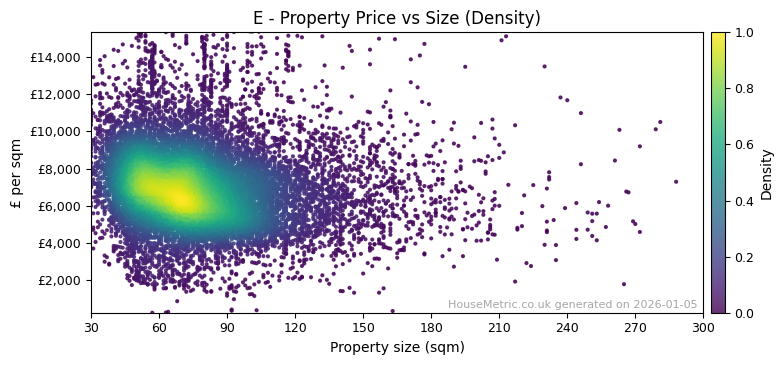
Shows the distribution of property prices per square metre in E.
Distribution by property type
Price per square metre distribution by size and property type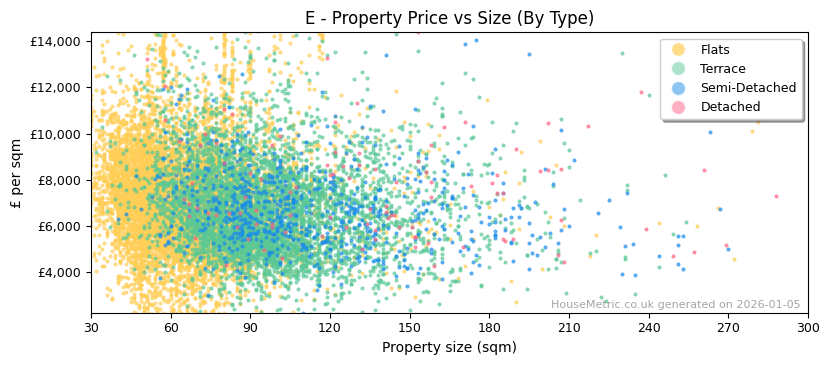
Shows the distribution of different property types in E.
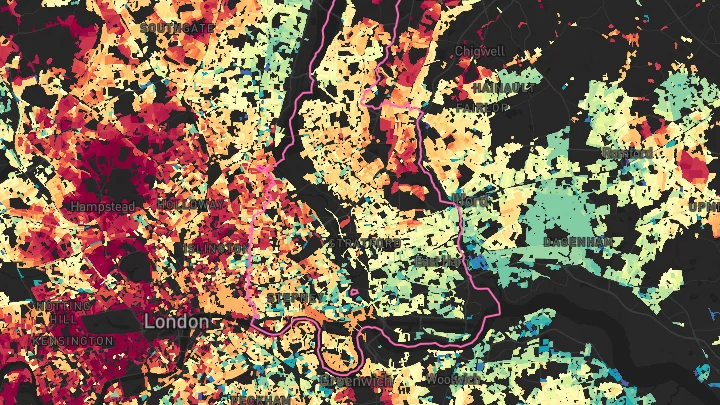
Property price map for East London
Have a look at the interactive price map I created for myself. Use it to explore house prices in 'East London' all the way down to individual property plots.
Price trends
House prices in 'E' East London fell -1.9% in the last year, -4.9% after inflation. Whether or not this trend will continue depends on many factors. I cannot tell what house prices will do in the future and don't believe anyone who says they can. However we can plot price trends, I have done this in the chart below for postcode area 'E' split by property type. You can extrapolate from this based on what you think will happen to wage growth, net migration, interest rates and the level of house building.
House price index for E
Tip: click on the legend items to show/hide different lines
Download house price index as CSV (premium users only).
The chart above shows changes in 'E' property prices over the last 20 years. The index is calculated from the average price paid per sqm for property in E and is set to 100 in 2004. The chart compares trends for Flats vs Houses in E. You can see how different they are. Keep this in mind when you see any price index that doesn't provide this breakdown.
The dashed lines show nominal house price changes, the solid lines show the same data adjusted for inflation. Economists call this the 'real' price change. You have to take inflation into account when comparing prices over time. It's calculated using the formula:
Real Rate of Return = (1 + Nominal Rate) ÷ (1 + Inflation Rate) – 1In this formula, the nominal rate is the rate of change before any adjustments, and the inflation rate is taken from the Consumer Price Index. The real rate of return is a more accurate measure of change in value, because £1 today does not have the same buying power as £1 in the past. For example, if a savings account pays an interest rate of 3% per year and the inflation rate is 5% per year, the real rate of return is -2%. This means that the investment's value is shrinking by 2% each year.
Historic returns for E
| All | Flats | Houses | ||||
|---|---|---|---|---|---|---|
| Nominal | Real | Nominal | Real | Nominal | Real | |
| 20 yr per annum | 3.9% | 1.1% | 3.4% | 0.5% | 4.6% | 1.7% |
| 20 yr total | 115.1% | 23.4% | 94.1% | 11.4% | 145.6% | 40.9% |
| 10 yr per annum | 1.2% | -2.2% | 0.5% | -2.8% | 2.2% | -1.2% |
| 10 yr total | 12.3% | -19.6% | 5.5% | -24.4% | 23.8% | -11.2% |
| 5 yr per annum | 0.9% | -3.9% | 0.4% | -4.3% | 1.5% | -3.4% |
| 5 yr total | 4.5% | -18.1% | 2.1% | -19.9% | 7.5% | -15.7% |
| 1 yr per annum | -1.9% | -4.9% | -2.1% | -5.1% | -1.6% | -4.6% |
| 1 yr total | -1.9% | -4.9% | -2.1% | -5.1% | -1.6% | -4.6% |
This table complements the house price index chart above, presenting the data in a more detailed format. It breaks down the information into 20-year, 10-year, 5-year, and 1-year periods, further categorized by property type. For each period, we display both a per annum rate of change and a total rate of change.
The total rate of change represents the overall change over the entire period. The formula for total return is:
Total return = (Index at end of period ÷ Index at start of period) - 1
The per annum rate of change is the annualized rate of change over the period. This is equivalent to the annual bank savings rate you would need to achieve the same total return over the given period. This annualized return is also known as the Compound Annual Growth Rate (CAGR). The formula for CAGR is:
CAGR = (1 + Total return) ^ (1 ÷ Number of years) - 1
Some specific examples:
- Over the past 20 years, Flats have seen a 0.5% annual change when adjusted for inflation. This translates to a total change of 11.4% in real terms.
- Over the past 5 years, Flats have seen a -4.3% annual change when adjusted for inflation. This translates to a total change of -19.9% in real terms.
Snakes & Ladders
See the recent winners & losers in the E property market. This is not deep analysis - it is a nosy, tabloid-style peek at the local property market.

E's constituents
The analysis on this page encompasses the entirety of E. If you want more granular analysis on different parts of E, use these links.
| Postcode district | Lower quartile | Median | Upper quartile | Sales in last 2yr |
|---|---|---|---|---|
| E1 Aldgate | £6,100 sqm | £7,450 sqm | £9,040 sqm | 989 |
| E10 Leyton | £5,670 sqm | £6,590 sqm | £7,720 sqm | 991 |
| E11 Leytonstone | £6,040 sqm | £7,110 sqm | £8,270 sqm | 1,191 |
| E12 Manor Park | £4,420 sqm | £5,070 sqm | £5,930 sqm | 381 |
| E13 Plaistow | £4,350 sqm | £5,000 sqm | £5,670 sqm | 507 |
| E14 Tower Hamlets | £6,020 sqm | £7,230 sqm | £8,590 sqm | 2,156 |
| E15 Stratford | £5,230 sqm | £6,110 sqm | £7,240 sqm | 783 |
| E16 Canning Town | £5,070 sqm | £6,100 sqm | £7,020 sqm | 1,521 |
| E17 Walthamstow | £6,360 sqm | £7,400 sqm | £8,390 sqm | 2,397 |
| E18 South Woodford | £5,440 sqm | £6,370 sqm | £7,300 sqm | 540 |
| E1W Moorland Way | £7,070 sqm | £8,460 sqm | £10,240 sqm | 552 |
| E2 Bethnal Green | £6,850 sqm | £8,040 sqm | £9,180 sqm | 780 |
| E20 Olympic Park | £7,600 sqm | £8,330 sqm | £8,860 sqm | 129 |
| E22 London | £10,800 sqm | £11,910 sqm | £13,450 sqm | 152 |
| E3 Mile End | £5,760 sqm | £6,790 sqm | £8,000 sqm | 1,201 |
| E4 Chingford | £5,090 sqm | £5,820 sqm | £6,620 sqm | 1,335 |
| E5 Lower Clapton | £6,530 sqm | £7,780 sqm | £9,220 sqm | 753 |
| E6 East Ham | £4,360 sqm | £4,970 sqm | £5,630 sqm | 814 |
| E7 Forest Gate | £4,710 sqm | £5,730 sqm | £7,030 sqm | 588 |
| E8 Great North Road | £7,530 sqm | £8,620 sqm | £9,780 sqm | 833 |
| E9 Homerton | £6,480 sqm | £7,730 sqm | £9,230 sqm | 575 |
Nearby geographies
The table below shows how 'E' compares to the other postcode areas nearby 'E'.
| Area | Lower quartile | Median | Upper quartile | Sales in last 1yr |
|---|---|---|---|---|
| SE- South East London | £5,210 sqm | £6,310 sqm | £7,670 sqm | 8,089 |
| N- North London | £5,720 sqm | £7,100 sqm | £8,880 sqm | 5,565 |
| IG- Ilford | £4,550 sqm | £5,340 sqm | £6,160 sqm | 2,257 |
| EN- Enfield | £4,560 sqm | £5,320 sqm | £6,190 sqm | 3,074 |
| EC- East Central London | £8,630 sqm | £9,910 sqm | £11,310 sqm | 339 |
| E- East London | £5,390 sqm | £6,580 sqm | £7,950 sqm | 6,607 |
Raw data
Our analysis of E is derived from what is essentially a big table of sold prices from Land Registry with added property size information. Below are three rows from this table to give you an idea.
| Address | Paid | sqm | £/sqm |
|---|---|---|---|
| Flat 11 87 - 91, Hackney Rd, | £525,000
Aug-2026
|
86 | 6,104 |
| 58, Walton Rd, | £615,000
Aug-2026
|
118 | 5,211 |
| 87, Howards Rd, | £500,000
Aug-2026
|
84 | 5,952 |
Search the raw data here.
About
I created HouseMetric because I wanted to see this data and analysis myself, I also wanted to teach myself to build a website. Please give me feedback or spread the word about it. I'm constantly tinkering and adding more stuff to it.