House prices in South East
Price per square metre data and charts to help you understand the housing market in South East - stats were last calculated on 01 November 2026.
Defining 'South East'
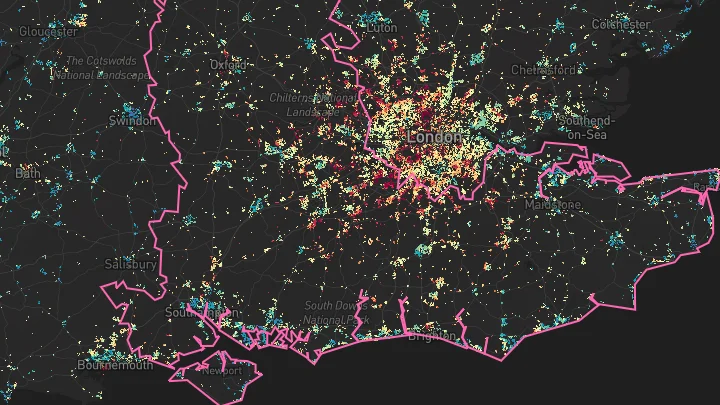
This boundary is taken directly from the Office of National Statistics area called South East. It is shown in red on the map below.
Want to change geography?
You can click on the map above to change to a neighbouring region, or you can use the search form below.
Price per square metre
Knowing the average house price in South East is not much use. However, knowing average price per square metre can be quite useful. Price per sqm allows some comparison between properties of different size. We define price per square metre as the sold price divided by the internal area of a property:
£ per sqm = price ÷ internal area
For example in September 2026, 129, Hythe Road, South East, TN24 8PN sold for £260,000. Given the internal area of 64 square metres recorded on the EPC, the price per sqm is £260,000 ÷ 64 sqm = £4,062.
England & Wales have been officially metric since 1965. However house price per square foot is prefered by some estate agents and those of sufficiently advanced age ;-). You can change your prefered units from square meters to square feet for all the graphs and charts on South East and elsewhere. Just visit the My Account page and look for the m2 to ft2 toggle switch. Alternatively just multiply everything by 10, move a decimal place to go from sqm to sqft and you'll be close enough as 1 sqm = 10.76391 sqft.
Distribution of £ per sqm for houses vs flats in South East
Tip: click on the legend labels to show/hide different property types.
The chart above is called a histogram, it helps you see the distribution of house price per sqm in South East To make this chart we put all the sales data into a series of £ per sqm 'buckets' (e.g. £4,385 to £4,641, £4,641 to £4,897, £4,897 to £5,153 etc...) we then count the number of sales with within in each bucket and plot the results. The histogram is based on 102,430 sales that took place in South East in the last 12 months.
Generate a custom histogram like the one above but based on your own criteria.
You can see the spread of prices above. This is because although internal area is a key factor in determining valuation, it is not the only factor. Many factors other than size affect desirability; these factors could be condition, aspect, garden size, negotiating power of the vendor etc.
The spread of prices will give you a feel of the typical range to expect in South East. Notably, only 25% of properties that sold recently were valued at more than £5,170 sqm. For anything to be valued more than this means it has to be more desireable than the clear majority of South East homes.
Box plot of £ per sqm for South East
Tip: click on the chart to see the values.
The chart above is called a boxplot (or a box-and-whisker plot). Box plots, like histograms, are used to graphically represent the distribution of data, showing the central tendency, spread of the distribution. In the context of £ per square metre property price distributions, box plots represent the variation in property prices within a geographic area e.g. South East. The chart above shows a boxplot for 'South East' broken down by property type (Flats, Semi-detached, Detached and Terraced). Almost everywhere houses command higher prices per square metre than flats, and detached houses most of all.
Box plot of £ per sqm for South East (New vs Old)
The box plot above for the South East region, is split by newbuild/existing as well as by houses/flats. It is interesting to see that the new-build premium for houses is -0.4%. Whereas the new-build premium for flats is 42.6%. This makes sense if you consider that older houses have more scope for extensions than new build houses. New build houses built to the maximum size a plot can take, tend to have smaller gardens. Flats are a different story, scope for extension doesn't play a role and interior standards matter more.
Does £ per sqm vary by property size and type?
A common question is whether price per sqm varies by property size and type. In other words can we fairly compare the price per sqm between two properties of different sizes? The charts below go some way to answering this question in the context of South East. TLDR; there is some effect, but after you control for property type the effect is less than you might expect.
The first chart shows the distribution of price per sqm by property size. This shows that as the size of properties increase, there is not a significant corresponding change in £ per sqm. The second chart shows the same distribution split by property type. Custom charts are available with a paid plan.
Density distribution
Price per square metre distribution by property size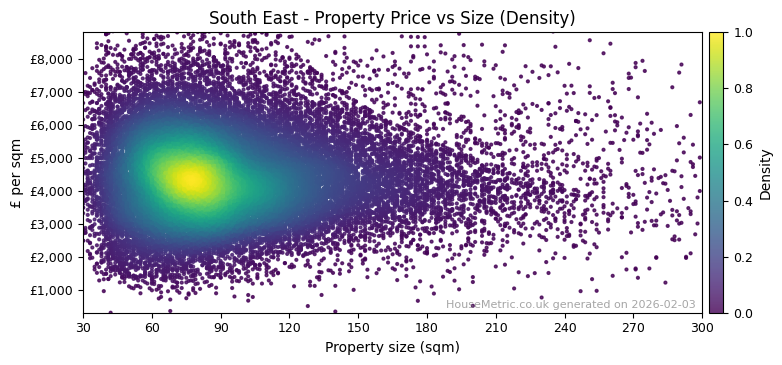
Shows the distribution of property prices per square metre in South East.
Distribution by property type
Price per square metre distribution by size and property type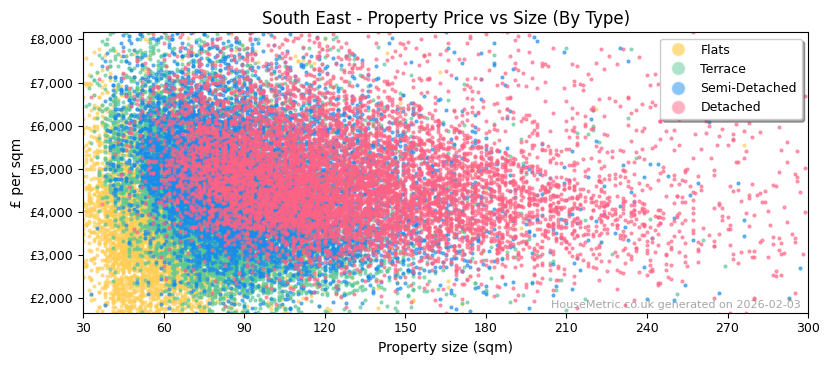
Shows the distribution of different property types in South East.
Property price map for South East
Have a look at the interactive price map. Use it to explore house prices in 'South East' all the way down to individual property plots.
Will South East house prices go up in 2027?
House prices in South East fell -1.3% in the last year, -4.3% after inflation. Whether or not this trend will continue depends on many factors. Nobody can tell what South East house prices will do in the future, but we can plot the price trends. The chart below plots price trends for South East, split by property type. You can extrapolate from this based on your own views on the future of wage growth, net migration, interest rates and the level of house building around South East.
House price index for South East
Tip: click on the legend items to show/hide different lines
Download house price index as CSV (premium users only).
The chart above shows changes in 'South East' property prices over the last 20 years. The index is calculated from the average price paid per sqm for property in South East and is set to 100 in 2004. The chart compares trends for Flats vs Houses in South East. You can see how different they are. Keep this in mind when you see any price index that doesn't provide this breakdown.
The dashed lines show nominal house price changes, the solid lines show the same data adjusted for inflation. Economists call this the 'real' price change. You have to take inflation into account when comparing prices over time. It's calculated using the formula:
Real Rate of Return = (1 + Nominal Rate) ÷ (1 + Inflation Rate) – 1In this formula, the nominal rate is the rate of change before any adjustments, and the inflation rate is taken from the Consumer Price Index. The real rate of return is a more accurate measure of change in value, because £1 today does not have the same buying power as £1 in the past. For example, if a savings account pays an interest rate of 3% per year and the inflation rate is 5% per year, the real rate of return is -2%. This means that the investment's value is shrinking by 2% each year.
Historic returns for South East
| All | Flats | Houses | ||||
|---|---|---|---|---|---|---|
| Nominal | Real | Nominal | Real | Nominal | Real | |
| 20 yr per annum | 2.9% | 0.0% | 1.7% | -1.1% | 3.2% | 0.3% |
| 20 yr total | 76.0% | 1.0% | 39.6% | -19.9% | 86.6% | 7.1% |
| 10 yr per annum | 1.9% | -1.4% | 0.7% | -2.6% | 2.2% | -1.2% |
| 10 yr total | 21.1% | -13.2% | 6.8% | -23.4% | 24.3% | -10.9% |
| 5 yr per annum | 1.1% | -3.7% | -0.1% | -4.8% | 1.4% | -3.5% |
| 5 yr total | 5.5% | -17.3% | -0.5% | -22.0% | 7.0% | -16.1% |
| 1 yr per annum | -1.3% | -4.3% | -2.6% | -5.6% | -1.1% | -4.2% |
| 1 yr total | -1.3% | -4.3% | -2.6% | -5.6% | -1.1% | -4.2% |
This table complements the house price index chart above, presenting the data in a more detailed format. It breaks down the information into 20-year, 10-year, 5-year, and 1-year periods, further categorized by property type. For each period, we display both a per annum rate of change and a total rate of change.
The total rate of change represents the overall change over the entire period. The formula for total return is:
Total return = (Index at end of period ÷ Index at start of period) - 1
The per annum rate of change is the annualized rate of change over the period. This is equivalent to the annual bank savings rate you would need to achieve the same total return over the given period. This annualized return is also known as the Compound Annual Growth Rate (CAGR). The formula for CAGR is:
CAGR = (1 + Total return) ^ (1 ÷ Number of years) - 1
Some specific examples:
- Over the past 20 years, All have seen a 0.0% annual change when adjusted for inflation. This translates to a total change of 1.0% in real terms.
- Over the past 5 years, All have seen a -3.7% annual change when adjusted for inflation. This translates to a total change of -17.3% in real terms.
Snakes & Ladders
See the recent winners & losers in the South East property market. This is not deep analysis - it is a nosy, tabloid-style peek at the local property market.


Transaction volumes
Property transaction volumes in the UK follow a cyclical pattern. In addition to seasonal trends that occur annually, transaction volumes fluctuate with changes in house prices. When prices are rising, transactions typically increase, whereas falling prices tend to result in fewer sales, with only motivated sellers (e.g., due to death or divorce) entering the market. Exceptions to this trend often occur when changes to Stamp Duty drive a temporary surge in transactions.
Number of properties sold in South East
The chart above shows the number of properties sold each month in South East as reported by Land Registry. Key events highlighted include the Northern Rock bank run at the start of the 2007/8 Financial Crisis, the introduction of additional Stamp Duty on second homes in April 2016, the COVID-19 lockdowns and subsequent Stamp Duty holiday, and the 2023 interest rate rises. It's important to note that Land Registry reporting is lagged, particularly affecting new build sales, so treat the last year of sales volume data with caution. Based on historical reporting lags, the yellow bars are a rough forecast of sales volumes for South East.
South East's constituents
The analysis on this page encompasses the entirety of South East. If you want more granular analysis on different parts of South East, use these links.
| Local authority | Lower quartile | Median | Upper quartile | Sales in last 1yr |
|---|---|---|---|---|
| Adur | £3,890 sqm | £4,460 sqm | £5,100 sqm | 685 |
| Arun | £3,190 sqm | £3,830 sqm | £4,480 sqm | 2,273 |
| Ashford | £3,250 sqm | £3,830 sqm | £4,340 sqm | 1,526 |
| Basingstoke and Deane | £3,510 sqm | £4,180 sqm | £4,860 sqm | 2,070 |
| Bracknell Forest | £4,050 sqm | £4,760 sqm | £5,560 sqm | 1,428 |
| Brighton and Hove | £4,400 sqm | £5,190 sqm | £5,980 sqm | 3,023 |
| Buckinghamshire | £4,110 sqm | £4,880 sqm | £5,760 sqm | 5,622 |
| Canterbury | £3,210 sqm | £3,830 sqm | £4,580 sqm | 1,738 |
| Cherwell | £3,480 sqm | £4,020 sqm | £4,620 sqm | 1,780 |
| Chichester | £3,630 sqm | £4,350 sqm | £5,080 sqm | 1,438 |
| Crawley | £3,700 sqm | £4,270 sqm | £5,000 sqm | 942 |
| Dartford | £3,910 sqm | £4,540 sqm | £5,140 sqm | 1,247 |
| Dover | £2,630 sqm | £3,310 sqm | £3,900 sqm | 1,454 |
| Eastbourne | £2,810 sqm | £3,320 sqm | £3,960 sqm | 1,238 |
| East Hampshire | £3,750 sqm | £4,370 sqm | £5,060 sqm | 1,455 |
| Eastleigh | £3,410 sqm | £3,950 sqm | £4,440 sqm | 1,724 |
| Elmbridge | £5,380 sqm | £6,360 sqm | £7,370 sqm | 1,578 |
| Epsom and Ewell | £5,100 sqm | £5,820 sqm | £6,550 sqm | 814 |
| Fareham | £3,400 sqm | £4,010 sqm | £4,540 sqm | 1,474 |
| Folkestone and Hythe | £2,820 sqm | £3,430 sqm | £4,150 sqm | 1,423 |
| Gosport | £2,620 sqm | £3,100 sqm | £3,690 sqm | 967 |
| Gravesham | £3,540 sqm | £4,070 sqm | £4,690 sqm | 965 |
| Guildford | £4,680 sqm | £5,420 sqm | £6,300 sqm | 1,499 |
| Hart | £4,130 sqm | £4,860 sqm | £5,460 sqm | 1,187 |
| Hastings | £2,720 sqm | £3,260 sqm | £3,840 sqm | 1,113 |
| Havant | £3,120 sqm | £3,680 sqm | £4,350 sqm | 1,414 |
| Horsham | £4,110 sqm | £4,760 sqm | £5,500 sqm | 1,775 |
| Isle of Wight | £2,370 sqm | £2,990 sqm | £3,610 sqm | 1,841 |
| Lewes | £3,570 sqm | £4,250 sqm | £5,040 sqm | 1,255 |
| Maidstone | £3,360 sqm | £3,990 sqm | £4,610 sqm | 2,059 |
| Medway | £3,100 sqm | £3,710 sqm | £4,330 sqm | 3,002 |
| Mid Sussex | £4,110 sqm | £4,760 sqm | £5,450 sqm | 1,917 |
| Milton Keynes | £3,150 sqm | £3,850 sqm | £4,460 sqm | 3,092 |
| Mole Valley | £4,850 sqm | £5,580 sqm | £6,360 sqm | 904 |
| New Forest | £3,640 sqm | £4,310 sqm | £5,100 sqm | 2,152 |
| Oxford | £4,630 sqm | £5,570 sqm | £6,630 sqm | 1,111 |
| Portsmouth | £2,620 sqm | £3,080 sqm | £3,640 sqm | 2,112 |
| Reading | £3,730 sqm | £4,300 sqm | £4,920 sqm | 1,704 |
| Reigate and Banstead | £4,430 sqm | £5,200 sqm | £5,980 sqm | 1,656 |
| Rother | £3,020 sqm | £3,710 sqm | £4,420 sqm | 1,262 |
| Runnymede | £4,490 sqm | £5,150 sqm | £5,920 sqm | 950 |
| Rushmoor | £3,580 sqm | £4,250 sqm | £4,900 sqm | 973 |
| Sevenoaks | £4,380 sqm | £5,160 sqm | £6,010 sqm | 1,281 |
| Slough | £4,080 sqm | £4,810 sqm | £5,650 sqm | 850 |
| Southampton | £2,780 sqm | £3,250 sqm | £3,750 sqm | 2,420 |
| South Oxfordshire | £4,280 sqm | £4,920 sqm | £5,610 sqm | 1,589 |
| Spelthorne | £4,570 sqm | £5,290 sqm | £5,950 sqm | 1,008 |
| Surrey Heath | £4,180 sqm | £4,830 sqm | £5,470 sqm | 1,028 |
| Swale | £2,930 sqm | £3,510 sqm | £4,100 sqm | 1,809 |
| Tandridge | £4,360 sqm | £5,020 sqm | £5,810 sqm | 898 |
| Test Valley | £3,440 sqm | £4,040 sqm | £4,640 sqm | 1,493 |
| Thanet | £2,660 sqm | £3,240 sqm | £3,890 sqm | 1,787 |
| Tonbridge and Malling | £3,880 sqm | £4,520 sqm | £5,220 sqm | 1,494 |
| Tunbridge Wells | £4,110 sqm | £4,800 sqm | £5,540 sqm | 1,313 |
| Vale of White Horse | £3,610 sqm | £4,210 sqm | £4,820 sqm | 1,567 |
| Waverley | £4,610 sqm | £5,430 sqm | £6,240 sqm | 1,466 |
| Wealden | £3,470 sqm | £4,080 sqm | £4,720 sqm | 2,055 |
| West Berkshire | £3,750 sqm | £4,390 sqm | £5,060 sqm | 1,821 |
| West Oxfordshire | £3,670 sqm | £4,330 sqm | £5,000 sqm | 1,265 |
| Winchester | £3,900 sqm | £4,650 sqm | £5,540 sqm | 1,461 |
| Windsor and Maidenhead | £4,690 sqm | £5,380 sqm | £6,180 sqm | 1,474 |
| Woking | £4,260 sqm | £5,130 sqm | £5,820 sqm | 1,245 |
| Wokingham | £4,430 sqm | £5,080 sqm | £5,660 sqm | 1,924 |
| Worthing | £3,500 sqm | £4,100 sqm | £4,720 sqm | 1,340 |
Nearby geographies
The table below shows how 'South East' compares to the other regions.
| Region | Lower quartile | Median | Upper quartile | Sales in last 1yr |
|---|---|---|---|---|
| North East | £1,290 sqm | £1,910 sqm | £2,500 sqm | 31,657 |
| North West | £1,900 sqm | £2,590 sqm | £3,280 sqm | 83,882 |
| South East | £3,500 sqm | £4,290 sqm | £5,170 sqm | 102,430 |
| Wales | £1,830 sqm | £2,470 sqm | £3,120 sqm | 33,347 |
| London | £5,110 sqm | £6,220 sqm | £7,840 sqm | 65,805 |
| South West | £2,890 sqm | £3,540 sqm | £4,230 sqm | 68,905 |
| West Midlands | £2,320 sqm | £2,940 sqm | £3,550 sqm | 57,998 |
| East of England | £3,060 sqm | £3,830 sqm | £4,760 sqm | 69,827 |
| East Midlands | £2,230 sqm | £2,780 sqm | £3,330 sqm | 56,111 |
| Yorkshire and The Humber | £1,860 sqm | £2,480 sqm | £3,150 sqm | 62,378 |
Raw data
Our analysis of South East is derived from what is essentially a big table of sold prices from Land Registry with added property size information. Below are three rows from this table to give you an idea.
| Address | Paid | sqm | £/sqm |
|---|---|---|---|
| 129, Hythe Rd, | £260,000
Sep-2026
|
64 | 4,062 |
| 23, John Dutton Way, | £535,000
Sep-2026
|
156 | 3,429 |
| 5, Lawrence Court, | £125,000
Sep-2026
|
46 | 2,717 |
Search the raw data here.
About
HouseMetric brings together Land Registry records, freehold boundaries, estate agent photos, floor plans, and planning applications into a single interactive platform.
Alongside raw records, it delivers deep property-market analysis and thematic heatmaps.
As a leading property data consolidator across England and Wales, HouseMetric is built to be the most comprehensive platform available.